Text and photographs are © by Ellen Spector Platt & Ellen Zachos, all rights reserved.


Showing posts with label bulbs. Show all posts

Thursday, April 25, 2013

SPRING FOR ORANGE AND PURPLE

I  bought and planted tulip bulbs Oct.'12 then promptly forgot what I had ordered. Rather than paw through my files I waited to see what would emerge. Turns out they were a rather dull, pale yellow;  I found it hard to believe that I had chosen such an insipid color.
But wait, after a week, the color started to turn, 'Daydreamer' Giant Darwin Hybrids in their full glory. The original color was paler than the stem on the left below; the color deepens as the flower matures giving each container a riotous look.
I have 7 containers on my roof garden, splashy enough to attract attention.
Purple and orange seems to be my theme this year, as the Muscari bloom in the tree pits along with pansies, daffs, and more tulips.
And around the neighborhood in my favorite window boxes, another designer chose Ranunculus and pansies...
and another gardener with hyacinths to enhance the front door color.
I hope none of these get ripped out, like four plants at my bus stop, below. This building opted to plant full pots of spring bulbs already in flower, not fall bulbs whose roots might grip the soil making it harder for thieves.
Back to my 'Daydreamer' on the roof with sumac 'Tiger Eye' waiting to leaf out.


Thursday, April 12, 2012

THEN AND NOW

Then. ( 2/25/08) Remember what snow looked like back in the day?
Now, or at least last Sunday in the Conservatory Garden, Central Park.
(Click on any photo to enlarge)

The two allees of flowering crab apple trees at peak bloom.
As a girl, this is what I thought Fairyland looked like.Tired of crabapples in bloom? Admire the bulb display. Next fall I must order 300 grape hyacinth to startle the larger bulbs in my tree wells .
Head north to the Harlem Meer, and see who's sunning themselves...and


Wednesday, December 14, 2011

WIN A FREE BOOK

Win a copy of Art Wolk's informative and hilarious book," Bulb Forcing: for beginners and the seriously smitten." All you have to do is comment directly below this post or for the tech challenged, email me and I'll add your comment section: 75 words or less describing your greatest success or failure in bulb forcing.

Garden Bytes publishers Ellen Spector Platt and Ellen Zachos will judge your comments and announce the winner on the blog. Entry deadline, Jan 2, 2012. The book is a beautiful hardback, signed by the author, published at $32.95 with free shipping courtesy of GardenBytes.com .(above, Crocus tomasinianus, 'Ruby Giant' forced in a pot)

Now is the time for New York City gardeners and all urban gardeners with tiny or non-existent outdoor spaces to think of growing bulbs indoors. Ok, you people with huge gardens are also invited to add the pleasure of winter blooms to your indoor space.

I've been forcing bulbs since girlhood but as I read Wolk's book I kept thinking with wonderment, 'I didn't know that.' He reveals all from his vast experience; how using a heat mat under a pot or increasing room heat forces the two or three amaryllis flower stalks within a bulb to shoot up and bloom simultaneously for a grand display.
I never realized that tap water that contains fluoride would probably kill the freesias I was trying to force (OMG, so THAT'S why...) Try layering your bulbs, explore a different species like anemones or ranunculus, plant a multi-species pot.(three photos above courtesy Art Wolk, from his book "Bulb Forcing." Directly above, Wolk's 13-division daffodil display at the 1999 Phila. Flower Show)

Maybe you don't want to compete for the big blue ribbon wins as Wolk does. I'm happy with a few hyacinths in water in a color to compliment my new gift African violet (see below). But in "Bulb Forcing" I discovered why my hyacinth stems are so short. If you want to learn the secret, win the book, or even (gasp) buy it.

Thursday, July 28, 2011

WHAT'S THAT PERFUME?

I went up to the garden to weed at 6am. In my head, I was concentrating on my newest writing assignment, not my garden. An aroma assaulted me that was hard to identify. I took a quick look around. The Asiatic lilies (Lilium) were in full bloom!
Sometimes in an indoor flower arrangement, the scent of lilies is overpowering. People pull off the stamens, then they throw out the whole stems just so they can breath again. These 'Stargazers' belong in the garden, where the perfume is miraculous, wafting on every breeze, if only for about 18 days.When I first moved to my farmhouse in Orwigsburg PA, I bought Barbara Damrosch's delightful book, 'Theme Gardens', and planted a scented garden right under my living room window as she recommended. But I was still a novice, and didn't realize that the peonies and irises that I planted there bloomed in May and we didn't open our windows until June.* So I could enjoy the aroma only by going into the garden, not in my living room. One more trial-and-error lesson taught by the garden.
*Original windows built in the 1850's had no counterbalancing weights. I could open them only my hopping up on the wide windowsills and, lifting from the bottom, propping them up with painted sticks. They were opened when it grew warm and closed in the fall except during an intense rain.

Thursday, March 25, 2010

SPRING PEEVES

At the top of my peeve list must be neighborhood stores, garden centers, and even the vaunted Greenmarket at Union Square where vendors sell tender crops like tomatoes and basil weeks before the last frost date.(double-click on any image to enlarge) What are they thinking? Where will these plants languish before they're planted by the gardener? Surely people aren't buying for their windowsill herb garden or their indoor hydroponic farm.
OK, I admit
that I planted
my pansies
March 15th this
year, but I
know that a
little frost,
even snow
won't hurt
them too
much. Plant
your sage,
chives and
thyme if you
want to, any-
thing peren-
nial, but the
vendors pictured top and below are complicit in garden failure. I can only think it's a way to get a second sale when the first plant fails in the cold weather. The Channel 1 meteorologist is predicting possible frost tonight. It's still March folks. Don't sell basil yet! (above right, ESP and her pansy 'hangover')2. For a consulting project, I've been thinking a lot about failure lately, and the roll it plays in the life of the novice gardener. I used to read some of those gorgeous gardening books by famous British writers, thinking I should be able to produce a similar garden. Well, the heat and humidity of a Philadelphia summer, not to mention the freezing winters, didn't exactly match a climate like Gloucestershire, England, and no publisher exactly made that clear. In fact the opposite. Gardeners from England and their publishers often imply that we could and should be doing what they do; another opportunity for failure, when a novice gardener doesn't know enough to even ask the climate questions.
3. A third opportunity for failure is offered by garden catalogs showing macro photos of tiny blossoms without showing the flower in a larger context. A buyer purchases a plant like the one above expecting it to be loaded with 6" blossoms, then must face the reality of 1/2" blossoms. It happened to with witch hazel. I read the description, saw the huge blossoms, and was later astounded by the discrepancies with what I got: small blossom on a shrub that held over its dead leaves from fall. (see above) Whose failure is that? Certainly not the novice gardener?

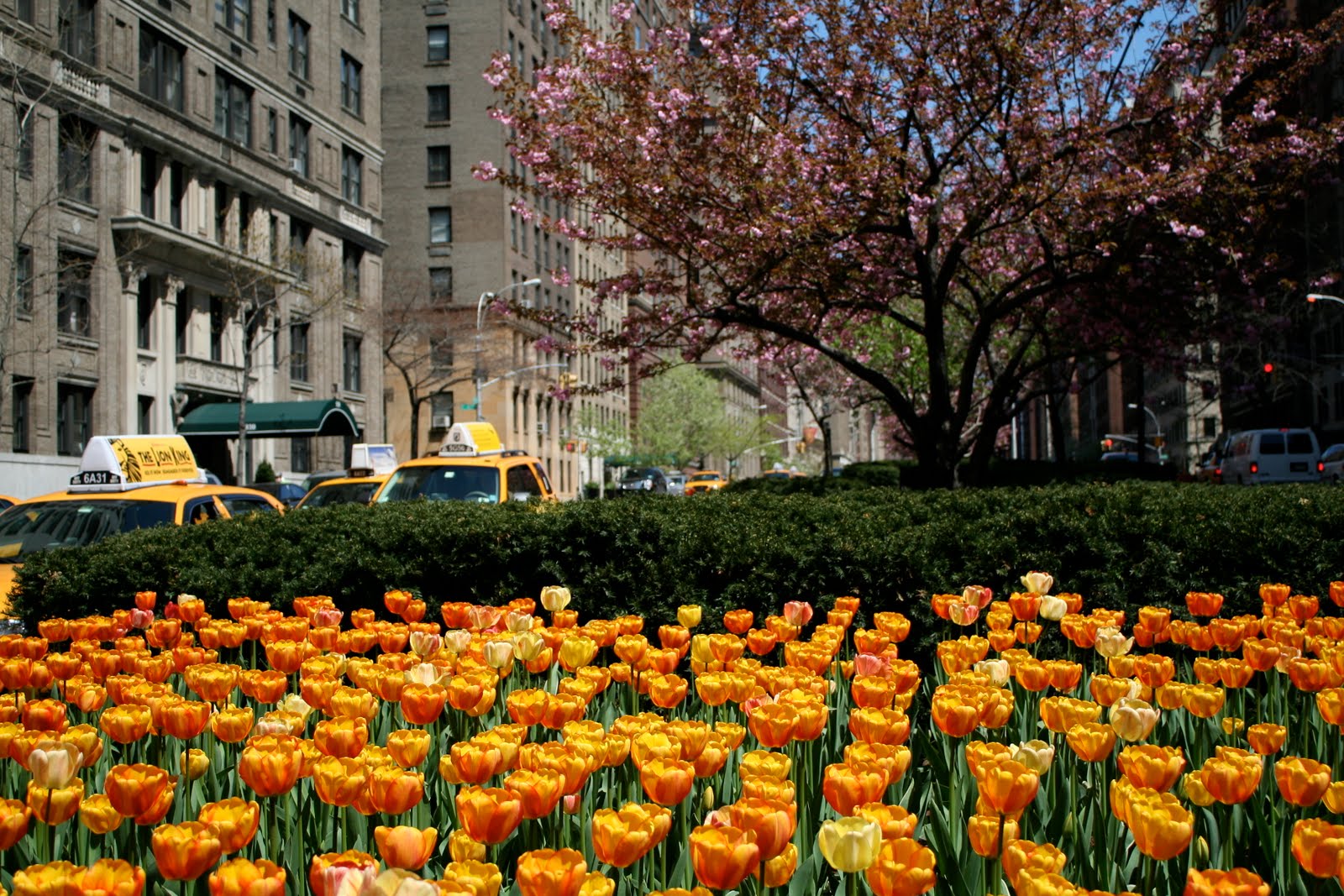
4. My fourth and last peeve (at least for now) are the plantings in the islands of upper Park Ave. I've heard that a special trust exists to support these plantings. Season after season there's a stage set of one type of flower, tulips in spring, begonias in summer for example. While I admit that the taxis and traffic lights make excellent foils for the color of the tulips, could we have some imagination please? An actual garden instead of floral theater?Now that I've confessed my current top four peeves, please write in your pet gardening peeves. You'll feel better for it.

Below, mid spring as I like it, at the Brooklyn Botanic Garden, 4/19/09.

Sunday, November 1, 2009

ORNAMENTAL ONIONS

By the fountain at Columbus Circle, New York City, a designer with a sense of humor plants decorative onions to reflect the globe sculpture across the street.

Giant allium bulbs are ready to plant now for next spring and summer bloom. In fall catalogs, they're usually bunched dismissively with "other bulbs" after the ever popular tulips and daffodils, an afterthought. But they have the advantage of being showy, deer and rodent resistant because of that oniony aroma, useful for container planting, and unlike daffodils and tulips, the seed heads continue to look great in the garden and in a vase long after the flower has passed. Above, seed heads in July add structure and style to a few plants of santolina.

Two or three large alliums
look like lollipops
sticking up from the
soil. Don't be stingy,
buy a dozen or more
to clump in one area
to look kinda natural.

Alliums have one
great disadvantage.
With most of the
ornamental onions
the foliage starts to
yellow or dies back
completely by the
time the flower
emerges. So place
your bulbs among
other leafy plants to
camouflage the die-
back, as shown here
in the herb garden
of the NYBG.

Although you wouldn't
know it from my im-
ages where the alliums
seem to be all purple,
they come in various
shades of lilac, pink,
white and even a true
blue and a yellow.
Be sure to check for
hardiness in your area
if you want them to last.

To the right, on The
High Line in late June
a display of astilbe in
the foreground, and
behind, foxtail lily
and drum stick allium
(A. sphaerocephalon).
Double click on this or
any image to get a
better view.

Try ornamental onions
in containers with other
plants, and the seed
heads will reward you
with their stately
presence. Full sun and
excellent drainage are
the two requirements.

I've had great success
forcing A. schubertii
on a sunny windowsill
in winter, and watching
the buds emerge and
unfold to look like giant
firecrackers. As the
foliage died back, I cut
some stems from my
boxwood shrub and
poked them gently into
the pot to provide a
complete cover-up.


Below are two arrangements with stuff I grew on my farm. The fresh arrangement includes drumstick and another small pink allium, globe thistle,
and several cone flowers, stems cut very short and stuck in wet floral foam.


The dried arrangement
is composed of stiff
necked garlic, and the
seed heads of Chinese
chives and Allium
christophii
stuck in
one of my favorite
vases. When you get
tired of the arrange-
ment, cook with the
garlic.

To learn more about
growing and using
anything allium, crafts
and original recipes,
see my book, 'Garlic,
Onions & Other Alliums',
by Ellen Spector Platt,
Stackpole
Books, 2003.

Sunday, February 1, 2009

ODE TO BECKY HEATH


She taught me in springtime, she taught me late fall
Cram bulbs in containers, smallest ones, top of all.

Plant in layers, in strata, biggest bulbs down beneath,
“Some soil between species, sun and water”, says Ms. Heath.

I forced in a basket, amaryllis in the middle,
Five perfumed narcissus, ten oxalis, sort of little.
Will they bloom by Jan.? (remember, I’m no techie),
Timing ….. problematic, but I trust bulb Queen Becky.

Five layers for summer, large pot out of doors,
With lilies and glads, and dahlias and more.Liatris is in there and oxalis encore,
Tiny rain lilies come last, crowded in to be sure.

When e’er you can’t tell which end to plant up,
Shall you plant on their sides? Ms. Becky says, “Yup”.www.brentandbeckysbulbs.com
photo above with glads ©Alan & Linda Detrick, Ellen Spector Platt design.

Monday, December 29, 2008

SHOWOFF


A few amaryllis bulbs transform my living room into a plant conservatory for at least six weeks in winter. I buy and plant them in mid-November, leaving their shoulders and necks exposed. When they hit daylight and drink some water the flower buds shoot up.
It’s not too late to get amaryllis started in January. Those you buy now have gone through a dormancy period at the bulb company and are ready to spring into flower.
Since flower stalks usually appear before foliage, I sometimes display amaryllis with houseplants and other winter experiments. Here from left , pineapple top rooting in a dish, hyacinth bulbs forcing in water, my aged
succulent carrion flower
(Stapelia gigantea)
in bud, and a cutting
from Ming Aralia rooting
in a vase.

The Stapelia bud soon
blooms like a giant
starfish, and
compliments the
amaryllis flower.

For the coffee table,
I stake the bare
amaryllis stems
with a few branches
trimmed from my
rooftop bayberry bush .
The branches help
support the green
stems, smell delicious,
and add visual interest.
Or I place an amaryllis
next to a few paper-
whites that have foliage
to spare.


If I’m fed up with an ungainly amaryllis that shoots too tall, I whack off the stem and treat it as a short cut flower. In water it will last at least two weeks.


When I lived in my
1850’s farmhouse,
the kitchen had a
walk-in fireplace
with no damper
on the flue. Cool
air poured down
in fall and winter.
Original pine folding
doors cut off the draft
from the rest of the
house. It was the per-
fect place to give
amaryllis bulbs the
cool, dark, and dry
they need to go
dormant before they
could re-bloom.In my
NYC condo it’s always
hot, with storage
space more precious
than diamonds. In a
gesture of extrava-
gance I consign bulbs
to the compost bin
after they finish
showing off each
winter. So sue me!

  © Blogger template Joy by Ourblogtemplates.com 2008

Back to TOP