Text and photographs are © by Ellen Spector Platt & Ellen Zachos, all rights reserved.


Showing posts with label perennials. Show all posts

Monday, July 8, 2013

WHAT GOES AROUND...

Gardeners are generous people. We're delighted to share divisions of favorite perennials or seedlings we've grown too many of. Eudora Welty honored the custom of pass-along plants in her famous novel, Delta Wedding. 
I used to host a day on my farm every spring called 'Plant Swap in the Barn', where customers where invited to bring five divisions in pots, (no mints please) and a covered dish for lunch. Everyone went home happy with precious new choices.
Now gardening in NYC I'm thrilled to be on the receiving end but I'm finding it harder to find the space to cram in the gifts I get.
Above, irises from Ellen Zachos, about five years old, planted with a rose 'Harison's Yellow'.
This rose was itself a gift from rose expert Stephen Scanniello, President of the Heritage Rose Society. When I got this, it was but a cutting in a four inch pot.
When Anne Kugel heard that I was looking for Montauk daisies, she promptly dug and divided some from her own NYC terrace containers, and gave me three clumps. Their bright white flowers are one of the last to burst into bloom in my fall garden.
Last summer Linda Yang schlepped a huge mound of northern sea oats to my door. I managed to
stuff it in an already full container. It's preparing to bloom right now and by fall should look like this...
What gifts!!!


Thursday, November 15, 2012

AUTUMN IN NY, B.S.

That's, Before Sandy. On the Sunday that the trains and buses shut down all over New York City I was at the Brooklyn Botanic Garden teaching my collage workshop. The winds had started but the rains were still holding off; my car service was scheduled to pick me up in 30 minutes to whisk me back to Manhattan. I had time to grab a few shots in the perennial border before I escaped, unfortunately not enough time to search for variety names. My apologies.
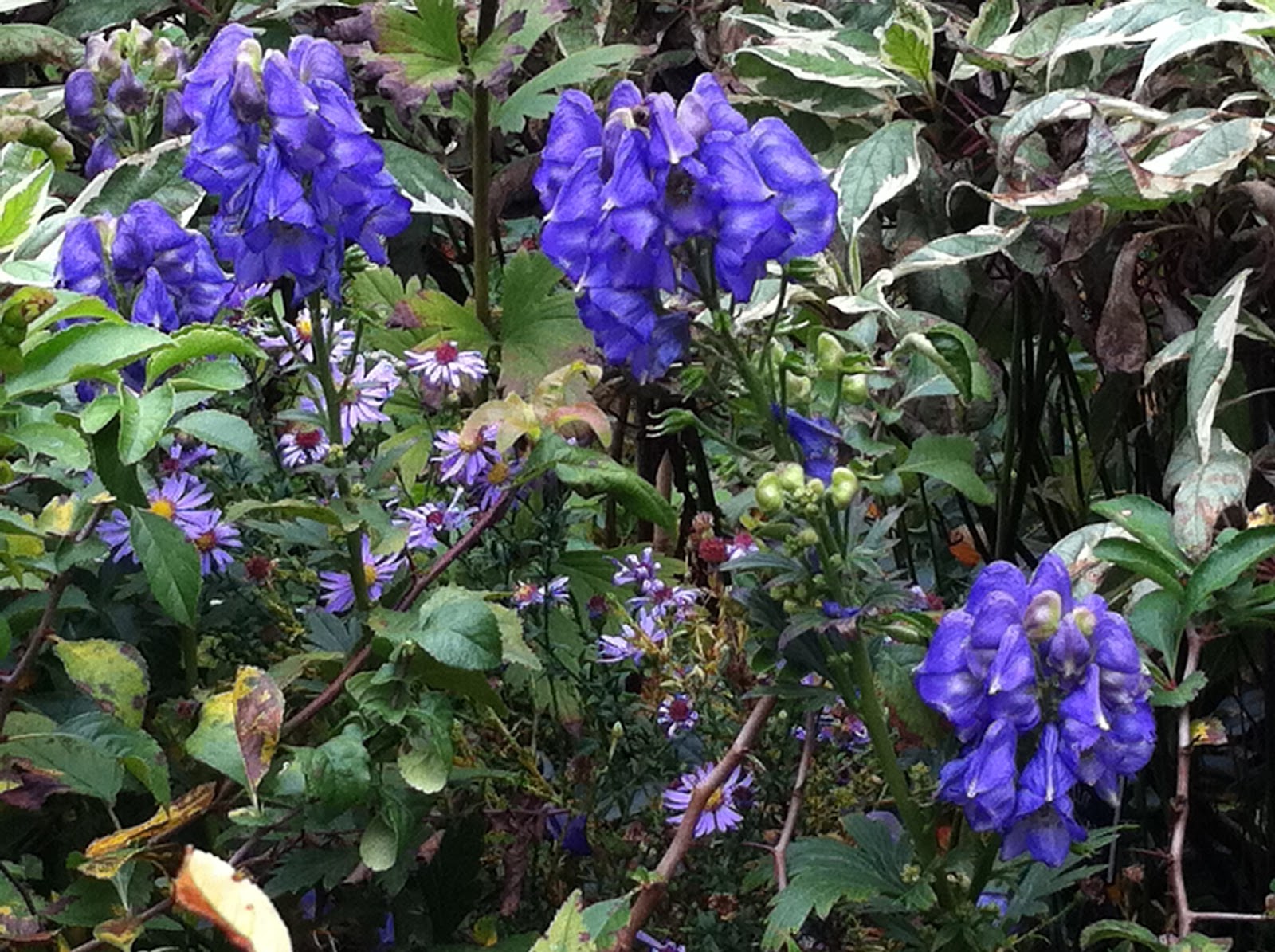
We're so eager for our spring gardens that we sometimes neglect to order for late fall, so I was curious to see what colors the BBG could provide on October 28. Purples predominated, both in these asters and in the monkshood seen below and in some foliage. I remembered that monkshood  (Aconitum) was always the last flower to bloom on my Meadow Lark Flower & Herb Farm, zone 5 in NE Pennsylvania. I had planted a row for drying; they keep their form and color spectacularly, but usually couldn't bear to pick those last blooms of the season.
Just when I think all is purple in the BBG border, there is a surprise with the bright white fall Anemone. It looks like a favorite I used to have, Anemone x hybrida  'Honorine Jobert'. It was a delightful reminder that I must order it this winter for my roof garden.


Thursday, June 7, 2012

NEW IN MY NEW YORK CITY GARDEN

I've been picking a crop of lettuce that self-seeded when I failed to rip out the tired plants July 2011. The lettuce went to seed, germinated and produced small leaves by Sept., then wintered over. It's a special treat to have free salads now.
A River Birch has just turned its fall color, beautiful in October, but in June. One of my hydrangeas was also crying out "LN, LN". Investigation showed that the tap to the automatic drip system had been shut off by person or persons unknown. The tap now has full body armor and the birch has started to drop all of it's leaves. I'm hoping it will re-leaf to get it through the rest of the summer.
One of my three Montauk daisies, usually the last perennial to bloom in my garden each October, is bursting into full bloom. It probably thinks that the pathetic season we went through in January and February was spring. After it finishes blooming I'll cut it back and hope for re-bloom in fall. Something strange is also happening in my boxes of annuals. Yes I knew my Calabrachoa had over-wintered for the first time in history, but now strange leaves are appearing both here and in the base of the flowering plum trees. My best guess is that a stealth gardener has planted pumpkin seeds. I'll leave them alone to see what happens.

Friday, August 26, 2011

NEW HIGH LINE

The second section of the High Line opened in mid-June extending the length ten more blocks, all the way to 30th St. I was there 7:30 am today eager to explore. There are new places to run,to meditate,
to view,and to contemplate.The cone flowers are departing and the goldenrods waiting to make their entrances.A brilliant garden designer placed coreopsis and blackeyed Susans in a site where, in the morning, the sun shines between buildings directly on them, while the surroundings are in shade.The Joe Pye and orange butterfly weed must be attracting butterflies, but I missed them.
My favorite feature in the new section is designed by Susan Sze a startling, delicate but arresting structure on either side of the path that is partly wildlife feeder, partly bird house village, and partly an abstraction of the cityscape. My photos can't do it justice, go see for yourself.
The last section of the High Line, the spur, running west from 30th St and curving into the Rail Yards, is still to be constructed, but you can see the path if you peek through the chain link fence.I've saved the topic of the dreaded High Line LAWN for a whole separate diatribe.

Friday, August 19, 2011

VACATION

What does this New York City garden writer do on vacation? Visit gardens of course. Helen Dillon's garden in a residential section of Dublin, Ireland is open to the public for 5Euros a visit. Dillon is a garden writer, lecturer, TV person, and thoroughly opinionated gardener, the best kind. This is not an estate garden but a home with nice sized plots in back and front yards, all within sight of the neighbors homes. Rare and common plants are crowded in together,in soil amended with homemade compost. Ireland, an island nation, has a maritime climate with mild winters and summers, Dublin averaging 47 degrees F. in winter and 67F in summer. Above the tree poppy, (Romneya coulteri) native to southern CA and Mexico, and winner of the Royal Hort Society Award of Garden Merit. This woody sub-shrub is perennial in Dillon's garden but would not be for me here in NYC. To start from seed it requires wild fire, and The Tree of Life Nursery in Calif. lights pine needles atop planted seeds to get them to germinate.

Examine the bright blue bachelor buttons below and double click on the image to look at the plants across the reflecting pond. Notice anything??? The bachelor buttons and many other annuals, perennials, and bulbs surrounding the pool are actually planted in unobtrusive pots, then moved around to fill in holes where certain plants have gone by. This garden is always lush. I've used the same technique in all of my gardens but never to this extent. Amazing. Below find my dear friend Dr. Diana W. from Wales amidst the pots and the flora.


Friday, June 10, 2011

ULTIMATE RECYCLING

(above, one pack of bachelor button 'Blue Boy' sown in 2006)
Here in NYC of course we recycle paper, plastic, metal, the usual stuff: garbage to the compost, good clothing to one of the many worthy thrift shops, books to the library for their sale. But the ultimate form of recycling happens on my roof top with little help from me.
Annuals that I've started from seed, resow themselves for the following year: Among the herbs, new dill, cilantro, calendula, viola and bronze fennel will sometimes emerge even in the same growing season. The flowers are well represented by bachelor buttons from the mother plants at top that show up here, and here
and here.as do portulaca, California poppies, spider plant (Cleome), and cosmos. I got a particular thrill this year when, in the space occupied by the only hydrangea that died over the winter, emerged a plethora of cosmos seedlings, enough to dig a few and plant in other in other bare spots around the garden. I've had second and third generations of larkspur and love-in a mist (Nigella damascene) as well.
Returning
Perennials also blow their seeds around the garden. Clematis found a home in the pot of black bamboo and in spring climb so rampantly that they cover the bamboo. Goldenrod, and blackeyed Susans are not weeds to me as they move from pot to pot on the wings of a slight breeze. I'm actually thrilled when I spy something in a new location and try to plot the path of the wind. I love to see seedlings pop up between pavers though I suspect it may not be the best for the roof membrane.This year I'm coddling two tiny seedlings that might be scions of my coral bark Japanese maple. (above) If they prove to be so, I'll buy new big containers and settle them in for a lifetime above 3rd. Avenue.
The Dilemma
Deadheading usually spurs the growth of both annuals and perennials. It's a task I thoroughly enjoy, the kind of mindless garden activity that's both productive and relaxing. My new spectacular lupines come with the instructions to cut off spent flower stems before the seedpods form. But if I do, they won't be able to seed themselves, as lupine are prone to do. Bigger, stronger mother plant, or potential babies? That is the question.

Saturday, March 13, 2010

FISH GOTTA SWIM, BIRDS GOTTA FLY

Seeds gotta grow, and now is the time.
(double click on any image to enlarge)
I used to time the planting of my first indoor seed trays to the end of the Philadelphia Flower Show. I'd come home from ten days at the show where I was selling my season's crop of dried flowers. I'd unload the truck, restore some order in the barn, and plant whatever perennial seeds I was trying that year. I started annual seeds about three weeks later.
Below, Jen's sweet pea 'Cupani' that she starts from seed and sets out in the cool spring of NH.Although I had been an inveterate planter of marigold and zinnia seeds since childhood, it wasn't until I needed to plant 200 foot rows on my farm that I was forced into expanding my seed repertoire. If I had had to buy all the plants, there would have been no Meadow Lark Flower & Herb Farm.

Low and behold, I found I could grow lavender, delphinium, yarrow, globe thistle, artemisia 'Silver King', Eryngium, Centaurea macrocephala, even day lilies from seed under the simplest home conditions. I had no heating pads, no grow lights, and didn't transplant seedlings into ever larger containers. What I had were 19 windowsills, wide enough to hold two or three standard planting trays with 48 or 60 cells each, bagged potting mix, and plastic wrap to keep in humidity till the seeds germinated. My ability to grow perennials from seed under these most primitive conditions was a revelation to me. Were plant nurseries in a conspiracy to prevent my knowing that for the $1.50 price of a seed pack I could grow 48 Lavandula angustifolia 'Hidcote'. Did I care if the plants were not identical? In fact I reveled in the differences.

In New York I have three long windowsills with very good light. The hardest part of growing from seed is choosing which plants to grow.
Three Rules for Growing Plants
from Seed
1. Read the back
of the seed packet.
2. Read the back
of the seed packet.
3. Read the back
of the seed packet.
Determine if the
seeds are better off
planted directly in
the garden, as my
sunflower and pop-
py packets say. Pay
strict attention to
whether the seeds
prefer to be cover-
ed with soil and to
what depth. Some
seeds need light to
germinate and get
no covering.
Pay attention to the timing. If you plant too early, your seedlings will get leggy indoors, and plants will be weak and scraggly.
This Years Choice
I need morning glories to climb up my fence. Despite all the new varieties I always gravitate to 'Heavenly Blue' for that gorgeous zap of sky in large flowers. The seed packet says soak overnight before planting, and oh yes I will.
I must have bachelor buttons, and choose 'Blue Boy' for even more heavenly blue. I'll plant these outside "as soon as the soil can be worked" says the packet from Renee's Garden. That will be this week for sure, as soon as the rain stops. If I don't deadhead assiduously, these flowers will drop viable seed and I won't have to replant next year. I'm happy to see them wherever the blow.The bachelor buttons in the photo above were all volunteers from two years ago, flying in among the David Austin rose, 'Crown Princess Margareta'.

This year I'll try for the first time Pride of Gibraltar (Cerinthe major atropurpurea)
The Cerinthe stunned me last summer in the gardens of Diana & John M. near Cardiff, Wales. It has dramatic purple bracts and foliage with a blue cast. I'm hoping that what grows in the Welsh countryside will look as dramatic on an 18th floor roof garden in Manhattan.
Below in Wales with calendula and poppies. And remember it's not necessary to have a doll tucked in your jacket when you plant your seeds, but who knows, it might help.Thank you to Renee's Garden Seeds, Ferry Morse Organic Seeds, Hart's Seeds, and Lilly Miller for feeding my seed habit and supplying me with free seeds to try.

  © Blogger template Joy by Ourblogtemplates.com 2008

Back to TOP