Text and photographs are © by Ellen Spector Platt & Ellen Zachos, all rights reserved.


Showing posts with label winter. Show all posts

Wednesday, February 5, 2014

MY NOW GARDEN IN NYC

On the 18th floor of my building, the garden I've tended for 10 years is dressed in snow. A bird perches atop the center of the iron fence.  Plenty of fruits and seeds are begging to be eaten: rose hips, Aronia and Virginia creeper berries, grasses and annuals seeds still clinging.
City kids make forts just as well as country kids; the materials may differ slightly.
Any signs of spring where you live?

Thursday, December 19, 2013

WREATH ADDITIONS

I made the wreath from fresh greens from New Hampshire (see blog post just below) and now want to add more natural decorations. I raid my stash, buried in a large plastic box in my NYC closet: okra pods and Devil's claw pods (aka cow catcher pods, unicorn plant pods) I grew on my flower and herb farm, still perfect after 15years; locust tree pods found on the streets of Manhattan; stiff neck garlic stems from Jen's NH garden, sorghum seed heads grown on my rooftop in NYC, one stray lotus pod and a dried papaya slice from god-knows-where; a couple of pine cones.
Materials which are completely dry will last for years, can be removed and saved as you would glass tree ornaments.
I tuck many of these elements among the green branches of the wreath as it lays on the table, along with a few small mandarin oranges from the market that add a zap of color. Notice a new candle in the center, lower and more subtle. Will I impress my book group coming for supper tonight to discuss Lowland?

Thursday, February 14, 2013

LET IT SNOW IN NYC


The latest blizzard forced me to flee Boston, abandon the New England Grows wholesale garden trade show, a Garden Writers meeting and my book-signing demo at the Andover Bookstore. All were cancelled because of this latest force of nature.
On my return to NYC I head out in the fresh snow to check on my own plants and those in a one block radius of my home (all I could manage before the sidewalks were shoveled).

I see my surroundings with fresh eyes.  It had been bitterly cold; above, the coral bark Japanese maple (Acer palmatum 'Sango-kaku') had turned, of all things, bright coral, something I wait for all year. Then the snow dust highlighted the color against the brick of my building where I had sited it.
The conifers in my roof garden looked particularly handsome,
while a block away, heavy snow on this yew tried to impede the progress of every passerby. I had never noticed this shrub before, yew being my least favorite evergreen. Now I was forced to pay attention.
And in the always serene garden of All Souls Unitarian Church, the snow highlighted a grouping of three wise men I hadn't seen before.
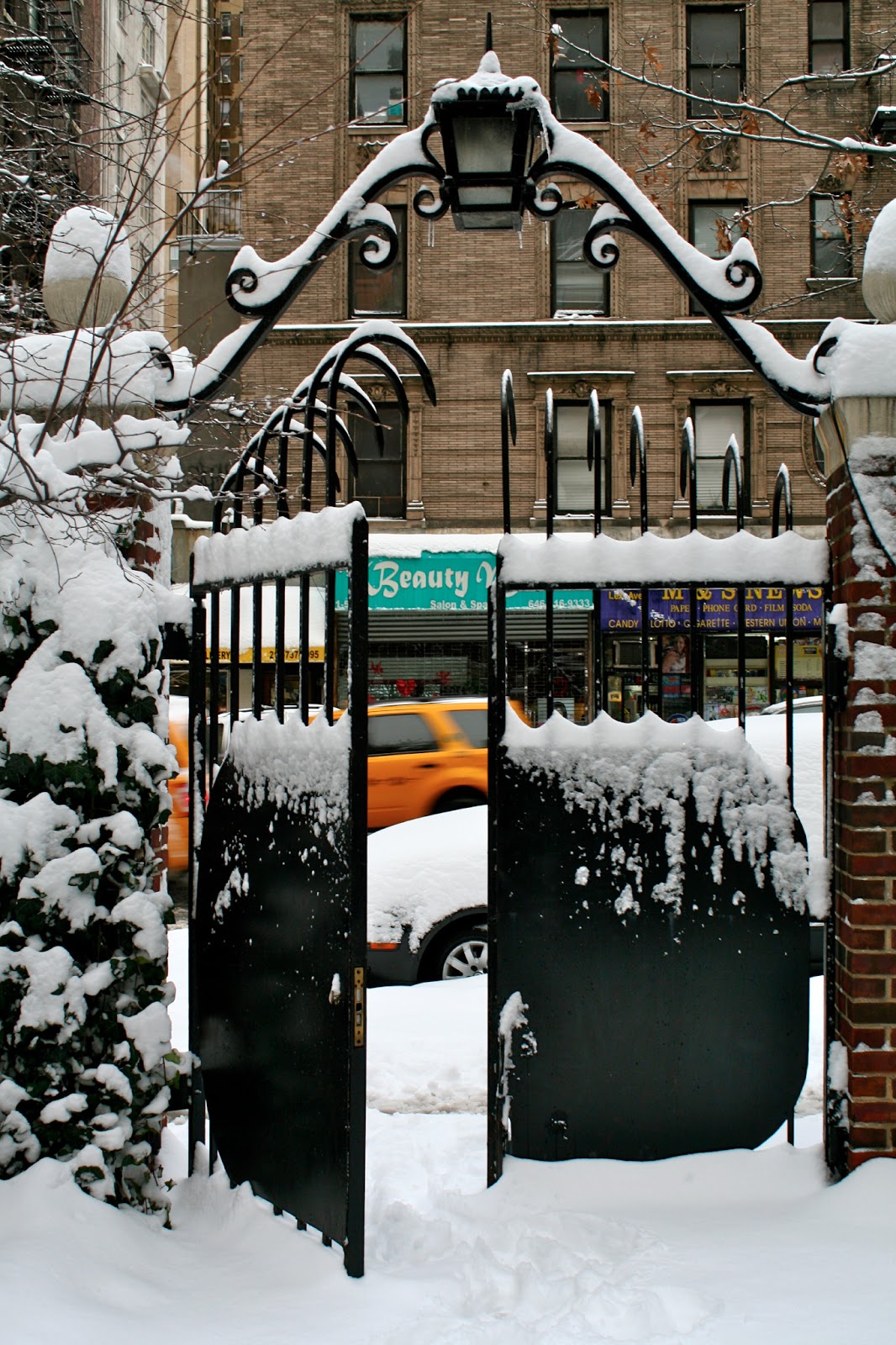
Leaving the garden, yet another enhanced site, the welcoming arch and gate, propped open even at 7am when I went out to photograph.
 And on my way home, more metal with snow.


Monday, January 28, 2013

MID-WINTER ON THE HIGH LINE

January 19th on The High Line and the Jelena witch hazel (Hamamelis x intermedia 'Jelena') startles with its blaze. The dead brown leaves don't drop but survive on the shrub's branches. At first I'm put off by the dead/live combo, but the sun shinning through the flowers is irrepressible.
Brilliant blue berries on juniper pair with grape holly (Mahonia x media 'Winter Sun')
in full bloom.
 Even where the trees and shrubs are totally bare, the colors of birch and willow bark make me appreciate the thought behind the plant choices. But plants aren't the whole reason for going to The High Line right now. Art abounds.
At 23rd. St when we entered we were greeted by this street art on an adjacent building.
Then unexpectedly there was a major piece using recycled pressed tin and mirror by Ghanaian artist El Anatsui. (below, partially hidden by the juniper, 'Broken Bridge II). 
 Reflections from nearby buildings incorporate themselves as part of the work. I didn't recognize the artist's name but the style kept niggling at my brain. When I got home I pieced together that he is the same artist I visit regularly at the Met Museum to pay homage to his  'Between Heaven and Earth'. He will have a major show of his monumental works at the Brooklyn Museum of Art from Feb. 8-Aug. 4, 2013.
If you're tired of looking at plants and art, try the ever popular New York sport of people watching.
What is the fascination of looking down on 10th Avenue?


Above, the Empire State Building, grape holly, winterberry, witch hazel, and Jen P. Hopkins.


Thursday, March 8, 2012

PLANT SURPRISES

Just when I think I know almost everything about gardening in Manhattan, I find out I don't.
On the roof of Milbank Hall, at the northern end of the Barnard College campus, 116th & Broadway, sits the Arthur Ross Greenhouse. It was built for students and teachers in the Biology department, for research and demonstration. AND it's open to the public free of charge on Wednesday afternoons from 1-3pm. If you go, you'll get an informative guided tour from either the greenhouse coordinator Krystyna Bucharowski, or one of her student assistants. It's great for the visitor to get all questions answered and great for the plant collection that visitors don't get a chance to pinch a vanilla pod in passing.Above, pods ripening on the vanilla bean vine (Vanilla fragrans) that reaches almost to the top of the greenhouse.
The main section of the greenhouse contains the tropicals. I saw many varieties new to me, like this great white bird of paradise (Streletzia augusta); I've only ever seen the orange one in the florist trade.The greenhouse hosts tours from schools in the neighborhood, and of course kids are fascinated by the food plants, like sugar cane, coffee bean and vanilla. But they also gravitate toward plants that DO something, like the sensitive plant whose leaves curl up at a touch, or the carniverous pitcher plant (Nepenthes alata) that collects water and insects in its vessels and 'eats' them.
I was waiting to go to the Arthur Ross Greenhouse 'til the dead of winter this year, when I most crave the sight and smell of plants, but winter never happened, so instead I went with LRK, one of my BFF who is a Barnard Alum, and visiting from the North. An excellent Judge of people and
their crimes, but no judge of plants, she was concerned that this Ruscus had bugs, until Ms. Bucharowski assured us they were only the flower buds, and what looks like leaf is really the stem.Above, plants that require a dry atmosphere have a room of their own, as do plants for special research.

So go to learn, go with your kids, grand kids, or BFF's. To arrange a group tour or to make sure the greenhouse isn't closed for school break, contact Kbucharo@barnard.edu, 212-854-5897.

Monday, January 30, 2012

NEW USDA ZONE MAP

Conservatory Garden, Central Park, NYC, Jan. 30
I used to garden in NE Pennsylvania where I had my Flower and Herb farm. It was in Horticultural Zone 5B at the time, showing that the average daily low temperature was-15 to -5 F. The new USDA horticultural Zone map published last week shows that that area of the coal region is now in Zone 6B.
When I moved to NYC, I was in Zone 6B. Now I garden in zone 7B according to the new USDA map. The data on which the map is based comes from 8,000 weather stations across the U.S. and shows that average low temps have shifted about 5 degrees upward since 1990. In practical terms it means that plants you once coveted for your garden may now be hardy; plants once on the hardiness borderline for your garden will probably now survive. Click here to see the new zone map.
The last map was released by the USDA in 1990; the new one is online and interactive. Once you go to the site and enter the captcha letters which are case sensitive, enter your zip code for a zone reading that takes into account altitude, winds, and other factors.
MicroclimatesWhat the map can never take into account are your microclimates, warmer or colder spots in your own garden. I garden in NYC on a windy roof top so what is that zone? I compensate for the wind by placing a precious crimson bark maple near a south-facing brick wall where it will be protected.
When I visited the Conservatory Garden in Central Park yesterday, I walked down the flight of 18 steps from street level at 5th Ave. to a nice sunken, protected bowl. Clumps of crocus leaves are nicely formed, the daffodil foliage has sprouted and the quince bushes have started to bloom. On my street, only 28 city blocks but a world away, these bulbs are still hidden underground and the quince buds are hardly swollen.
On a garden tour of San Antonio TX ten years ago I was startled to learn that the famous River Walk meandering through the downtown was a whole Zone warmer than the sidewalk at street level, a one 'story' above.
So read the new map, pay attention, then evaluate your own space and take whatever risks you want.
It's a Wrap
If your climate is really too cold for your tree you can always wrap it to keep warm like this one on York Ave.

Tuesday, November 8, 2011

BERRY NICE

Other Ellen's post last week reminds me of the value of berried plants in the fall landscape in NYC. In our winter enthusiasm to get immediate color in spring, we often give short shrift to fall interest.
Here are 5 shrubs with berry interest, planted with fall and winter in mind. Above, chokeberry (Aronia arbutifolia) in container on my roof garden, and below, a few clusters of the berries 'pruned' for decoration indoors. Firethorn (Pyracantha) has small white uninteresting flowers in spring but shines in autumn and throughout the winter. In small spaces, prune it as an espaliered tree in a container against a wall. Below, it appears in a built-in planter in front of a NYC townhouse.
Fall flowers/spring berries, a reverse of the usual plan.
Above, Oregon grape-holly at the Central park Zoo last Dec. 31. The flowers are followed by blue-black berries in spring, below. Note to Other Ellen: I've read that the berries are edible. True? have you tried them?If you have a larger garden, smooth sumac berries are a fall mainstay, and last all winter.
I've always coveted a Beauty Berry (Callicarpa dichotoma) for the surprising color of its fruit. Maybe 2012.

Saturday, February 19, 2011

ROSES IN WINTER

On Park Avenue New York City, from 67th Street to 57th St. roses are in full bloom since January.So are the bugs...and thorns.Artist Will Ryman constructed his rose garden from stainless steel, fiberglass, marine paint and brass.They'll remain in place through May according to the NYC Parks Dept.
Just wondering, what will happen to the tulips beneath which are always planted in fall and burst into bloom in May?Did someone plan the colors of the tulips this year to compliment the roses?Thirty eight roses ranging from three to twenty five feet tall.Yet I'm more attracted to the bugs, both beneficial...and maybe not so much.Sixty fallen petals, can be used as chairs, though the day I took these images, temperature 26F, wind chill minus a thousand, not too many wanted to lounge around. I wished I would have shot in the snow. I went to this exhibit merely to report but came away a believer, just as I had scoffed about The Gates in Central Park before I got involved in the fun. For sheer playfulness, The Roses is a winner.

Monday, December 20, 2010

FROM ONE, MANY

My first boyfriend, age 10, went with me to empty lots to help me cut 'free' flowers to bring home. I loved him.
Last week when the SunflowerGuy.com offered me a free bouquet of my choice in exchange for a review, I jumped. I've grown about 20 varieties of sunflowers from seed; used them for seed snacks, for drying, for cut arrangements and in the garden. Can you tell I love them?

SunflowerGuy says that through their parent company Dos Gringos, they are the largest grower of ornamental sunflowers in the world; I'm the smallest, so it's a match.
The overnight flower delivery from SunflowerGuy came on the date requested, in an ingenious shipping box that included a simple, tasteful container and the stems wrapped in rubber bands to keep the bouquet intact. See above.I followed all of the instructions for removing and discarding the wet flower foam that kept flowers healthy during shipping, cutting the bottom of the stems, adding the cut flower food. I smiled even without the instructions at the cleverness of the packaging and the cheery sunflowers within. Then I spied the red-painted seeded eucalyptus. The online catalog had said nothing about painted flowers. ugh! It was probably because the red pepperberry was still green and some designer thought the red element was necessary. Not for me.
One Makes Four
While many people, if not most, love an arrangement that is complete, fun for me is doing my own. In fact most florist designed arrangements have enough flowers & foliage for 4-6 arrangements, so I always divide them up and scatter them around the apartment, even the bathroom.
Having fresh flowers wherever I turn is a wondrous thing. When you scroll to the bottom of the post you'll see how I handled the dreaded painted eucalyptus.The five sunflowers went in a collection of glass vases made from recycled soda bottles, one or two stems to a vase. How easy is that? The good looking container that came with the arrangement will not languish but will become part of my varied collection of useful vases.The St. John's wart and a tiny bit of pepper berry went in two small bud vases on a bathroom shelf.These three stems lean gracefully in a contemporary vase in the living room. They look like they'll last well beyond the guaranteed 8 days.In the tree wells in front on my building (this one where the dead tree was chopped down) I lay fresh greens, with additional prunings from the roof garden, including some stems of aronia berries, dried sorghum seed heads and the red painted eucalyptus that even I have to admit doesn't look half bad there. I hope The Sunflowerguy approves.
As I write this post I'm on my seventh day and all flowers are still in excellent condition. If you need an overnight flower delivery, especially for sunflowers I think you'll be well satisfied.

  © Blogger template Joy by Ourblogtemplates.com 2008

Back to TOP