Text and photographs are © by Ellen Spector Platt & Ellen Zachos, all rights reserved.


Sunday, May 9, 2010

wild about wild onions


I have nothing against garlic. I like garlic. But I ADORE onions, and wild onions (Allium canadense) are my favorites. The taste is strong and kind of combines onion and garlic (to my refined palate) so it's a much loved ingredient in my kitchen. This year I'm determined to harvest enough wild onion to get through the entire year; yesterday I picked and dried the first of several batches.

Wild onion is considered a weed by most people, along with its cousin, wild garlic (Allium vineale). Wild onion has blue-gray, solid stems that grow to about 18" tall. All parts of the plant have a distinctively onion-y smell, so there's no chance of poisoning yourself with a similar-looking plant, as long as you have a sense of smell.

(photo courtesy of Purdue University)

Wild onion is easy to harvest. Bulbs are usually single, shallow rooted, and pull out of the ground easily, leaving only the smallest hole behind. (Wild garlic tends to grow in clumps that have a more desperate grip on the surrounding soil.)


Because wild onion bulbs usually grow singly, they are relatively easy to clean. A brief rinse is all it takes. (Wild garlic tends to have numerous small bulbs that hold soil tightly between each bulblet. )


Now is the perfect time to harvest wild onion, before the plant sends up a stalk that produces flowers and bulblets (which shatter and propagate themselves). Producing the stalk draws on energy stored in the bulb and decreases its size.

What are the ethics of foraging a crop that results in the death of said crop? Any time the edible part of a plant is the root or bulb, you're not leaving anything behind to regrow for next year when you harvest. Of course you wouldn't do it on private property without asking, and in general, wild onion is considered a pest plant...plenty of people spend considerable time and money trying to eradicate it from lawns and fields. I don't know how the City of New York feels about it, and I'm not sure I WANT to know, since ignorance is bliss (although no excuse in a court of law). But I'd be interested in your opinions...

Wednesday, May 5, 2010

BIG BAMBOO

Sunday at 9:30 a.m. I ran through the amazing hallways of the Metropolitan Museum of Art and up the last flight of stairs to savor in solitude the new exhibit created by twin brothers Doug and Mike Starn. Of course there were three guards, one guide and the security chief, but I was almost alone for about ten minutes. The construction is made of some 5000 bamboo poles secured by miles of nylon rock climbing ropes in varying colors and thicknesses. Three different species of bamboo grown in Georgia and South Carolina are part of the form. A team of rock climbers installed the first section rising 30 feet off the roof, overlooking the greenery of Central Park and the skyline of Central Park South. They lashed the culms together in a seemingly haphazard way, though I'm told that there is a grand plan with drawings and everything. Visitors will witness the evolving incarnations of Big BambĂș as it is augmented throughout the spring, summer, ultimately reaching 50 feet high and wide. (above, more poles for the next phase)
After agreeing to a long
list of conditions and
registering in advance,
visitors can stride with
a guide up through the
heights of the structure.
The guide's talk drifted
down to the terrace
below as I admired one
of my favorite parts of
the roof garden, the
old wisteria vines,
now in full bloom amidst
the bamboo stanchions.


The Met web site says that the exhibition shows the "cresting wave that bridges realms of sculpture, architecture, and performance. Set against Central Park and its urban backdrop, Big BambĂș will suggest the complexity and energy of an ever-changing living organism".

My fascination stems from the plant itself, this quickly renewable resource now used in flooring, table ware, and even fabrics. In China, scaffolding is made of bamboo because it's strong, cheap and readily available.
Bamboo is also colorful and beautiful and excellent as a living screen. I'm growing black bamboo in containers on my rooftop. Some clematis dropped in (apparently from seed blown from a neighboring container, and are now climbing up the culms. But more about that another day.

Friday, April 30, 2010

The Jolly Gardener...and I don't mean me


I spend a lot of time thinking about potting mixes, don't you?

So much of my work is in containers that finding a quality potting mix is crucial, and not always easy. There's a trade off between being light weight (significant for rooftop plantings) and providing adequate nutrition (peat-based mixes don't supply as many nutrients as topsoil), and it's tricky finding just the right balance. One of the questions I'm asked most often is which brand of mix do I recommend.

Big box stores carry Scott's Miracle Gro almost exclusively, but frankly, that's not good enough. Sun Gro's Metro Mix 560 and 310 are fine, but they're usually sold in wholesale nurseries, so recommending them doesn't help the home gardener.

Last year I was introduced to a new product: The Jolly Gardener line of potting mixes.


You might recall I started a comparison test last fall. I transplanted Montauk daisies and dusty miller (among other things) into two large, identical, stainless steel containers with two different brands of potting mix. This spring, the herbaceous plants in the Jolly Gardener mix are twice as large as their brothers and sisters just a few feet away. (I've included a solar panel in each photo to show scale.)

planted in Jolly Gardener


not planted in Jolly Gardener


I'm the first to admit that this is a single, small experiment; I don't have enough data to make sweeping statements about the best potting mix ever. But I'm excited about the Jolly Gardener product and plan to keep using it. I look forward to seeing how it performs throughout the season.

Jolly Gardener is available in several formulas (regular, moisture mate, fruits/vegetables) at independent garden centers and nurseries. It may cost a little more than a non-premium brand, but I consider it money well spent. I don't mind paying a few more dollars for superior quality, do you?


Monday, April 19, 2010

BIG APPLE GARDEN KLUTZ

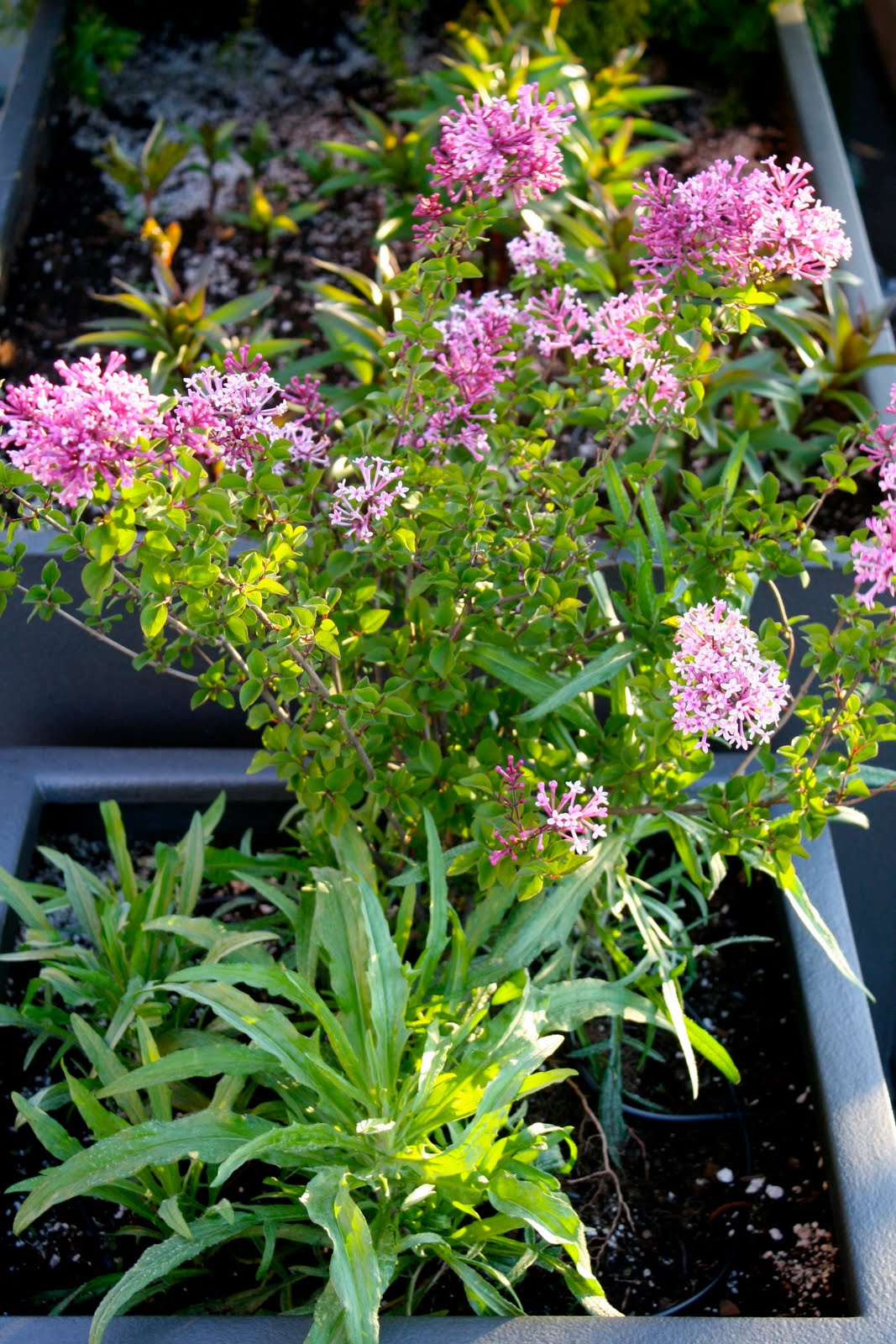
It's 7am on my newly replanted rooftop. The chokeberry (Aronia arbutifolia) is in full flower, promising a huge berry crop for fall. The dwarf lilac
'Bloomerang' is at peak
and will continue to
bloom throughout the
summer if I'm
assiduous about dead-
heading, a task I love.
All is serene.

But there's a snake in the Garden of Eden, a 150 foot garden hose, long enough to reach the far edges of the garden. It's just waiting for me to water in the transplants. I'm thinking of how I'll saw up the black bamboo and plant it in two containers, what I'll use to fertilize the roses, what variety of Monarda to order. I trip on the hose. I teeter and crash into the sharp edge of the new planter.Barely able to move without stabbing pain I finally go to my doctor, an avid gardener. He finds tears in the cartilage connecting my ribs to my sternum. We agree on the diagnosis, 'Garden Klutz'. He says he'll find the code in his directory of medical diseases so he can bill my insurance for the x-ray. He doesn't yet know if there is a sub-code reserved solely for New York City Garden Klutzes, but he rather thinks there is.

I've been called by many epithets, of course: ' herb lady', ' garden lady', 'wreath lady', 'lavender queen', and while still a psychologist, ' trouble maker' for whistle-blowing on the County Mental Health Administrator who was derelict in his duties.

I think 'Garden Klutz' has a certain ring to it. Daughter Jen says she once followed the Abbot & Costello routine and actually stepped on a rake and was hit on the head by the handle.
Have you ever been a Garden Klutz? Tell me please.

There's no picture of the actual accident. The image below is after the fall. Those planter edges look totally innocent don't they?

Wednesday, April 14, 2010

herbs make you happy (and pak choi doesn't hurt)


Sometimes life is tough. There isn't enough time in the day, deadlines loom, responsibilities seem overwhelming. What do you do? Take a deep breath and get to work.

This morning my task was a true tonic: planting herbs and a few edibles for two clients who have just recently become interested in growing food. We started slowly last year with a few tomatoes and this spring I've added lettuce, some spicy purple pak choi,

and "Bull's Blood" beets.

These plants look as good as they taste, and add color, shape, and texture to any container.

It's too early for hot weather crops like tomatoes, peppers, and eggplants, but greens are perfectly happy with night time temps in the 40's. Peas also thrive in cooler temperatures and will soon be wrapping their grasping tendrils all along that terrace railing.

Similarly, it's too early to plant sweet basil, but rosemary, dill, lovage, and sage are happy happy happy.


And after a morning in the garden, so am I.


Saturday, April 10, 2010

REFLECTIONS ON CHERRY TREES

Washington DC seems to own the US brand on cherry blossom festivals but I'm enamored of the cherry trees that grow in Brooklyn. Having gone to the Brooklyn Botanic Garden last year about this time, I wasn't planning to go again so soon, yet daughter Jen was in town, escaping from the still-winter of New Hampshire. We agreed BBG was a must-see. There's always something new, or a different way of viewing a favorite scene. Alan Rokach, noted garden photographer and my first photo teacher, says that when you think you've shot a subject in the best way possible, there's always another way. (double click on the photo above to enlarge).
Ben, Jen & I arrived early last Saturday morning joining a small group waiting to take advantage of the relative serenity. By the time we left at 1pm the crowd of viewers had intensified. This group of young people were gazing at the koi in the pond below. Another favorite stopping off place was the log crammed with basking turtles across the pond, near the bridge.At Magnolia Plaza in
front of the main
building, the deep
magenta Magnolia
'Vulcan' drew all
eyes. Every group
of family or
friends had at
least one camera:
our group of three
had three, and we
all took shots of
'Vulcan' This one
is courtesy of Ben.

The cherry blos-
som story will
continue to unfold
for the next few
weeks, as differ-
ent varieties
come into bloom.
It's worth a trip to see the spectacular Cherry Esplanade of Prunus 'Kazan' first planted in 1921. The yellow Magnolias 'Elizabeth' is also on its way to full bloom. If you're like me, beware the crowds on the official festival, May 1&2. If you love to people watch, by all means go then.

The Paper Bush that attracted attention on my post of 1/28/2010 was in full bloom this trip. When I first laid eyes on it in January the big buds looked like popcorn puffs. Now the flowers are more like powder puffs. Looking great from January through April is a hard trick in any New York City garden. Though my hort encyclopedia lists this Edgeworthia as hardy in Zones 8-10, it sure looks like a NYC winner to me.

Tuesday, April 6, 2010

bad behavior in Central Park

We're having HOT weather here..hot for April anyway. The first flush of spring brings the hordes into Central Park, most of them happily enjoying the flowers, the rental bikes, the luscious spring air.

Then there were the two kids (one boy, one girl), maybe 6 years old, who thought it might be nice to kick a tree. A noble plane tree that never hurt them in any way. Hard kicking followed by poking with pointy sticks, picking and prying at the bark, lifting off pieces and throwing them away. Why?

But more importantly, why were these two 6 years olds allowed to behave so badly when their two mothers were a mere 5 feet away? They must have been having a VERY important conversation, since they didn't seem to notice the arbor abuse going on right under their noses.

(Pardon the blur, I was zooming. And yes, I realize they don't look like bad people. But arbor abuse speaks for itself.)

I stopped, incredulous. I thought. I weighed my options. I yelled across the park drive, "Hey!" No response. (And my voice carries, ask anyone.) I thought again. I walked across the drive. I addressed the children, "You have GOT to stop doing that." They stopped immediately. Then I addressed the mothers, "PLEASE do NOT let your kids DO that to the TREES!"

They looked at me and murmured, "Ok." Were they mortified by the bad behavior of their offspring? More likely they were afraid the crazy tree lady was going to do them bodily harm. Which I wasn't. But ladies, if tending one child is more than you can handle, hire a babysitter. Or leave the kids at home. They're putting a cramp in my spring style.


  © Blogger template Joy by Ourblogtemplates.com 2008

Back to TOP