Text and photographs are © by Ellen Spector Platt & Ellen Zachos, all rights reserved.


Saturday, November 24, 2012

THE GLOBAL KITCHEN @ AMNH

Introducing Lucy Platt Guest Blogger.
 I went to the  American Museum of Natural History. I saw the plant exhibit it showed how you can grow  plants in a apartment. there were all sorts of plants.chives, cabbage and all sorts of other plants they had growing there.
 In the other plant and food exhibit there was a "reguler" water melon and a sqare water melon the sqare is grown by puting it in a box when it as just a small fruit but you must keep it on the vine until you are ready to eat it.
 Potatoes come in alot of shapes, colors,and sizes there are pink, purple, red, yellow, and alot more.
 Back in the olden days before they had any supermarkets they would use just an out door flat spot and they would set up what we call a farmers market all the people would go around and get all that they needed for there families.


Hi there! Guest Blogger Annabelle Platt here today! I went to the American Museum of Natural History. There is currently an exhibit there called the  "Global Kitchen." It's about how people grow and eat food around the world, how agriculture has changed, and about the rising problem of too many people and not enough food. 
 But over-producing is also a problem. For example, fishermen have been taking the fish from the seas. Obviously, they want the big strong fish, not the puny one that'll feed maybe half a person, right? But they have taken so many of the big fish that most of the ones left are little and under-developed. It's a big problem. 
Talking about how agriculture has changed...well, now scientists can cross-breed DNA. Maybe they like how this plant grows quickly. Maybe they also like how this plant that grows really slowly is really crunchy and sweet. They can take characteristics like that from plants and breed them together, so they have two things they like in one plant. You know how berries always look smaller in the wild? That's because farmers are going to plant the biggest seeds from the previous year, so they get bigger berrries. Melons? The original melon was very small and hard and bitter. Overtime they have become big balls of water and sugar (plant sugar, not artificial sugar.) Gardeners can even make watermelons square! 
 Waste. Geez, you don't even want to know how much an average person throws out in a year. I'm going to tell you anyway. The average person throws away/discards 414 pounds of food per year. For a family of four? That's 1,656 pounds of food. That's a LOT. So next time you're looking at the menu and thinking I'm gonna get the double cheeseburger with extra fries, maybe the thought that crosses your mind next could be Am I really going to eat all of this, or am I just going to throw it away? 
For further information about the American Museum of Natural History in NYC visit ... The exhibit is on until August 11, 2013


Thursday, November 15, 2012

AUTUMN IN NY, B.S.

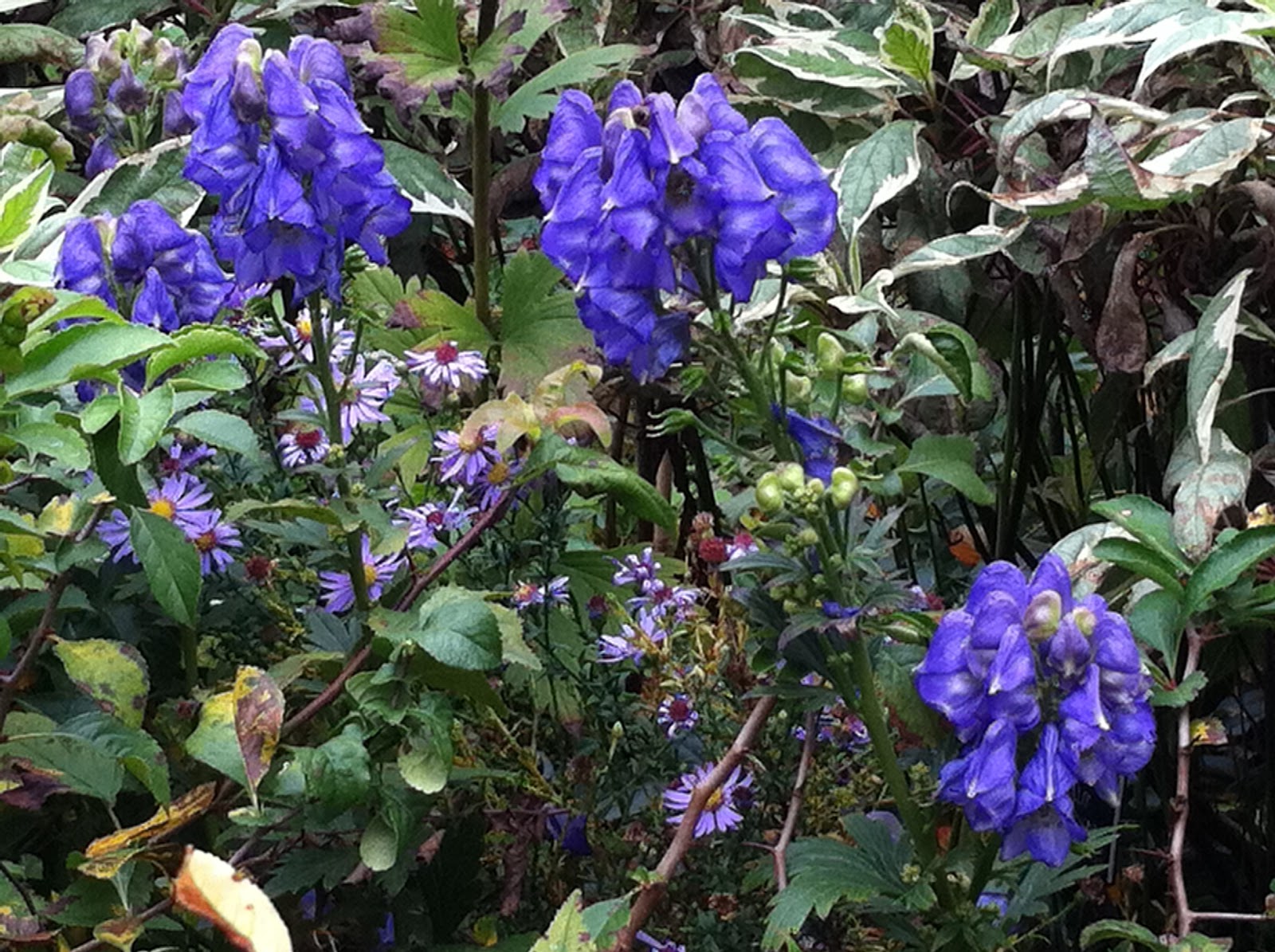
That's, Before Sandy. On the Sunday that the trains and buses shut down all over New York City I was at the Brooklyn Botanic Garden teaching my collage workshop. The winds had started but the rains were still holding off; my car service was scheduled to pick me up in 30 minutes to whisk me back to Manhattan. I had time to grab a few shots in the perennial border before I escaped, unfortunately not enough time to search for variety names. My apologies.
We're so eager for our spring gardens that we sometimes neglect to order for late fall, so I was curious to see what colors the BBG could provide on October 28. Purples predominated, both in these asters and in the monkshood seen below and in some foliage. I remembered that monkshood  (Aconitum) was always the last flower to bloom on my Meadow Lark Flower & Herb Farm, zone 5 in NE Pennsylvania. I had planted a row for drying; they keep their form and color spectacularly, but usually couldn't bear to pick those last blooms of the season.
Just when I think all is purple in the BBG border, there is a surprise with the bright white fall Anemone. It looks like a favorite I used to have, Anemone x hybrida  'Honorine Jobert'. It was a delightful reminder that I must order it this winter for my roof garden.


Wednesday, November 7, 2012

PRUNE VINES NOW

My American wisteria (Wisteria frutescens) looks great both spring and fall, and though this species is nowhere near as rampant as the Chinese wisteria, it still needs some pruning. Despite blooming on new wood, NOW is when I want to prune, so now I shall because I want to make a small wreath for a Thanksgiving centerpiece. I'll have plenty of vine left to support bloom in spring.
So I prune eight 3-4' long pieces after the leaves have dropped (or strip off leaves), and just start wrapping, using no wire or clips of any kind. Form the first strand in a rough circle or oval shape and twist the ends around the circle to hold it. Continue with all your other pieces of vine. My finished wreath is 10" in diameter, perfect for putting on a platter. Note the small seed pod, bottom left which I've left in place.
I just pile up some fresh fruit for decoration and to be eaten but the vine wreath base will last for years. If you don't have wisteria use whatever woody vine you need/want to prune, like kiwi, honeysuckle, even clematis.
If you form the wreath before a heavy freeze sets in, the vine will be perfectly pliable, but even if you've waited until winter, you can always soften the wood by soaking overnight in a bathtub of warm water.
 My wisteria spring 2012, and below in fall before dropping leaves.

Monday, October 29, 2012

BOTANICALLY INCORRECT:SONORAN DESERT


Walking in the desert near Tucson AZ, each time I clicked my camera I imagined the collage that I would make when I got home. Here it is and here's how I did it. (click on any image to enlarge)
If you scroll down to the post just below this one, you'll recognize many images that I printed out on plain paper on my very ordinary home printer. Then I cut away all semblance of sky because I wanted to create that myself in my collage.
On a desert path I, whose balance is problematic even on a straightaway, was super-aware to watch out for wayward thorns. But in my collage I wanted to exaggerate the prickliness of the cacti so I cut some of my images with spiked edges as seen above.
Starting with the sky of torn papers, I glued my way down to the first cut image of the hills bathed by evening light. I added a swath of tan, textured paper for the ground,
then layered the various cacti, smaller near the top of the collage, bigger images layered over them to create an illusion of distance. At the bottom, I cut an image of a huge rock at the Sonoran-Desert Museum and glued on some actual desert soil.  No color manipulation in Photoshop but I took great liberties with relative sizes and placement of the plants. Notice a little yellow sun added to the sky just at the end. Purchase price $275. Contact Ellen Spector Platt.


Monday, October 22, 2012

NYC GARDENERS WANDER THE DESERT

Other Ellen and I went to Tucson AZ last week to a national Garden Writers Symposium, tours of public and private gardens, lectures about the newest plants and newest media, networking.

I showed my new book, "Artful Collage from Found Objects", in the Trade Show and found  columnists, bloggers, radio and TV hosts who promised to spread my fame, if not fortune. As luck would have it my book has a desert-inspired cover, albeit with dried green foxtail weeds, not cacti.
Three Tucson garden hosts fed us lemonade made with prickly pear cactus fruit, all made much too sweet for my taste.
We were too late for bloom in the Sonoran Desert but saw remnants of other fruits like that of the fishhook barrel cactus.

 and the teddybear cholla. (below)
And as the sun set in the West, Other Ellen and I cut our afternoon lectures and drove with two other writer/photographers to the fabulous Saguaro National Park where we learned that cactus spines not only protect a plant from animals but offer some shade and shield it from drying winds.  The  saguaro cactus, icon of  old Westerns, may be 75 years old before it sprouts an 'arm' and lives 175-200 years.
When it dies, the woody ribs inside were used by the local Tohono O'odham tribe for building shelters and fences.


Saturday, October 13, 2012

ROOT PRUNING TO SAVE A TREE

What's wrong with this tree?   Nine years ago I planted two in 30" pots, both flowering purple plums, with regular drip irrigation.  Buffeted by winds on the 18th floor roof garden, one lists badly, the tips on both have many bare branches, bloom is now about 80% less than four years ago, and they are generally unattractive.
Replace or replant? I chose the latter for now, a potential savings of about $500.
First I drastically pruned the tops with my Fiskars long-handled pruner, my all-time fav gardening tool. Then, a better idea, since the trees were coming out of their pots anyway, I waited a bit to complete the top pruning job. Two strong men from the building staff provided the muscle and a crucial tool, an electric Sawzall. Because these containers have an interior lip the tree can't just be loosened and pulled out. One man loosened some soil with a spade,
the other ran the saw blade down in the dirt about three inches from the lip,
then with the muscle in four strong arms and two strong backs laid the tree on
an old canvas.  I could complete my pruning job easily, cutting both the top of the tree and some of the roots, trying to release other of the roots from the compacted ball.
A little new soil, less than half a bag and the tree is comfortably back in place, about1/3 smaller than it was before. As a woman of a certain age, notice that I saved the easy jobs for myself.
And yes I do realize that there are uneven spaces and some unattractive cut off sticks, but always an optimist, I'm thinking that the new spring leaves will hide all that. Time will tell.

Friday, September 28, 2012

book reviews and give away!

Dear Readers,

Ellen & Ellen are offering two new and very different books as giveaways. We've reviewed them both below and look forward to judging  your comments! Write a few sentences about your favorite discovery growing edibles (if you want book # 1) or orchids (if you want book # 2).  It might be something most gardeners know but you unearthed for yourself, or a secret you're ready to share with the world. 

We're looking for personal experiences, either positive or negative. Please post your comments by Oct.12th and we'll announce by Oct. 19th.  And please don't enter for both books; we want to spread the literary joy as wide as we can.


The Hamptons & Long Island Homegrown Cookbook, by Leeann Lavin is a lavish book of conversations with farmers from the fertile North and South Forks of Long Island, along with top local chefs. Leeann  profiles these Farmers and Chefs as co-dependents in the dance of the local harvest. Large and lush photographs by Lindsay Morris & Jennifer Calais Smith make you want to run this weekend to one of the fabulous restaurants that base their menus on local and seasonal crops at their freshest.

Farm-to-plate is a hot topic these days, and on Long Island it makes a lot of sense because the crops are so diversified; from seafood of all types caught by local fishermen, to local wine from the vineyards, cheeses, and of course the greens, beets, corn, tomatoes, raspberries; fruit and veg of all kinds. Recipes look extremely flavorful, yet simple to produce, enticing enough to try.

In a regional book of this kind, part of the fun is in personal recognition; my moment came in the profiles of Chef Eberhard Muller and his wife Pauline Satur of Satur Farms.  I had dined in Paris at the Michelin three-star L'Archestrat where Muller had been chef and where I  first tried a miraculous new concept called a tasting menu.  Now living in Manhattan, I order my groceries online from Fresh Direct, which offers a special category of local foods; Satur Farms greens have often been on my marketing list.

This book will surely please you if you have any connection at all to the area, or know someone who does. ESP


Aphid in my Eye gives the reader a nostalgic glimpse into a bygone era of orchid growing, when orchid societies stressed SOCIETY and orchids were high-priced rarities, rather than big box store loss leaders.  Tom Powell's memoir is a humorous, fast read, full of idiosyncratic caricatures and stories just weird enough to be believable.  Most of all it's a love letter to his wife Betty, with whom he survived encounters with a wife-swapping deacon, a psychic who spoke to orchids, and a chauffeured orchid thief who cried poverty.  Aphid in my Eye is an entertaining book, written with horticultural know-how and love. EZ


  © Blogger template Joy by Ourblogtemplates.com 2008

Back to TOP